
Decision Season: The Verdicts Are Starting to Land
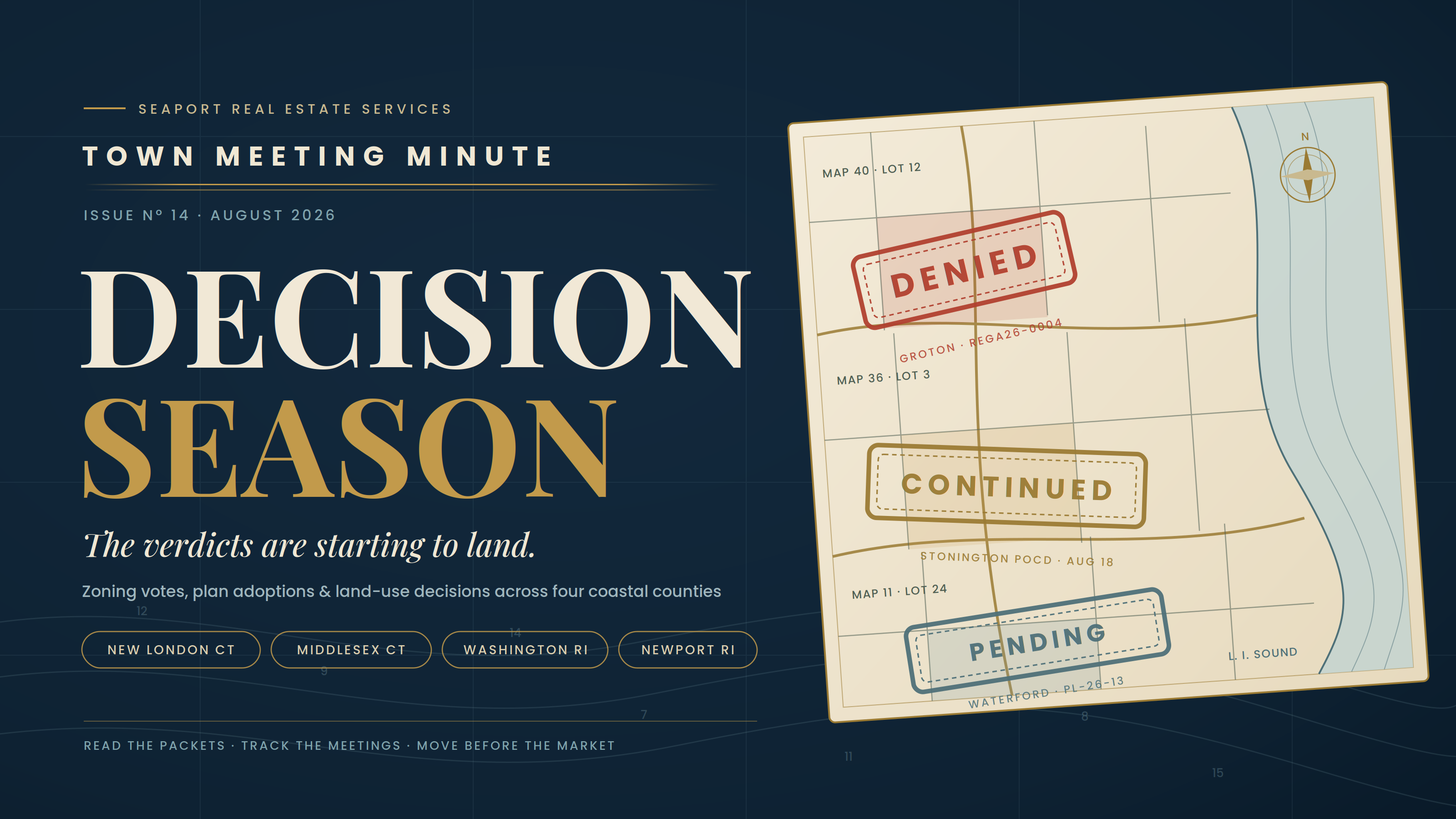
For months we have tracked towns writing frameworks, drafting plans, and scheduling hearings. Now the region is entering decision season. Stonington's ten-year plan goes back to public hearing August 18. Waterford is weighing whether to adopt its own rezoning of the former airport property. Groton just denied a follow-up amendment. Tiverton set a September special meeting on its most contested commercial project. What towns decide over the next thirty days will echo through land value for the next decade.
Issue #13 was about municipal control — towns taking ownership of the rules. Issue #14 is about what happens when those rules meet the voting stage. Public hearings are being continued under crowd pressure, follow-up amendments are being denied, long-litigated commercial projects are being forced toward final answers, and regional housing-finance tools are quietly being positioned in the background. This is the phase where watch-list items become recorded decisions, and recorded decisions become market facts.
Top Story
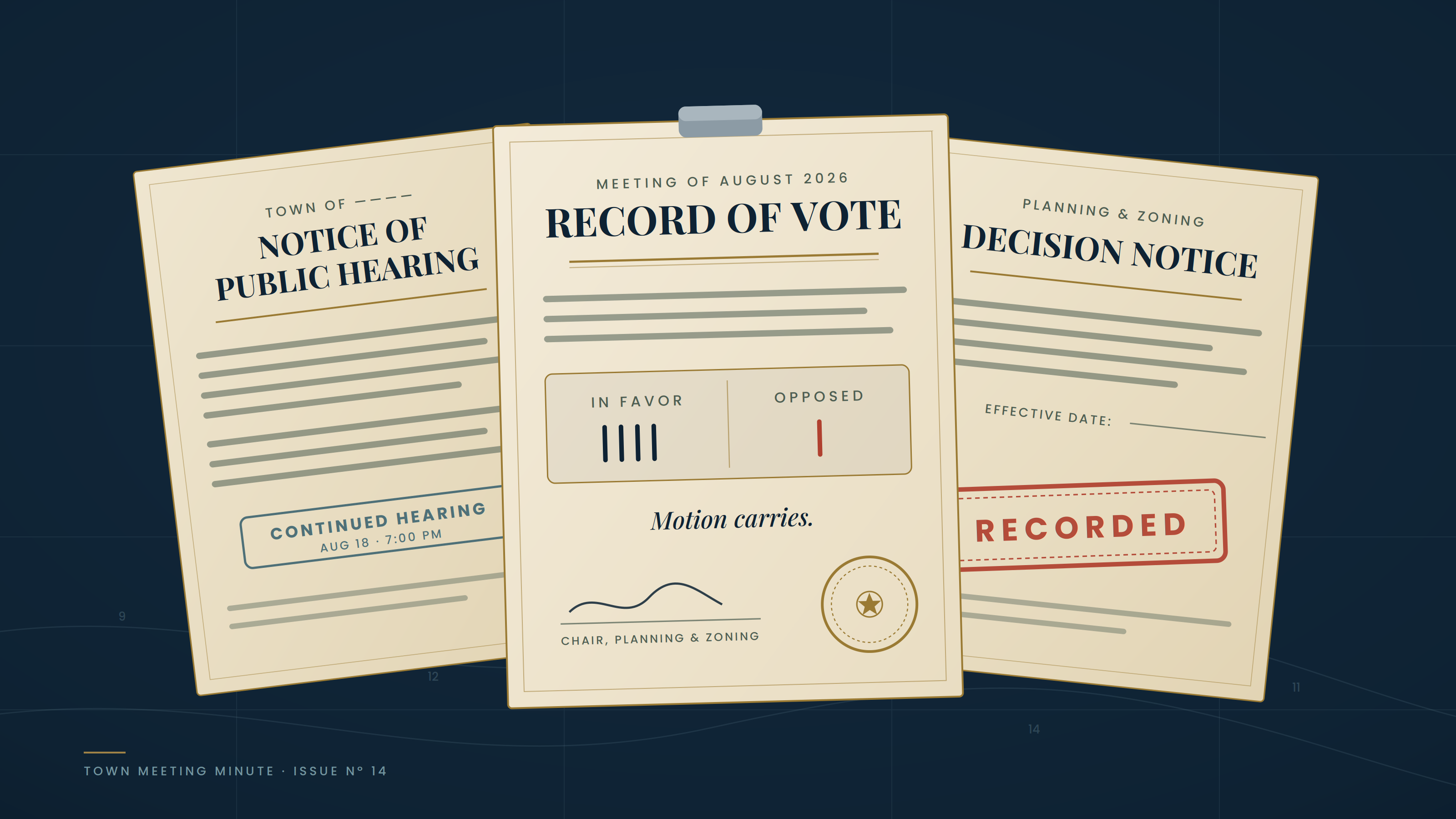
Stonington's Draft 2026 POCD hearing drew a crowd, ran nearly two hours, and was continued to August 18 — with plan amendments now on the table before adoption.
Key Window
August 18 through September 15, 2026 — the continued Stonington hearing, the Waterford rezoning decision watch, September agendas, and Tiverton's special meeting all land in this stretch.
Big Theme
Frameworks are colliding with public pressure. Not everything is passing — and the denials are telling us as much about market direction as the approvals.
How to Use This Issue
Use this issue as a decision tracker. Several items from Issue #13 have now produced outcomes — a denial in Groton, a continued hearing in Stonington, a special meeting in Tiverton — and several more will produce outcomes within the next thirty days. The goal is to identify which decisions are about to become final, which parcels and corridors they touch, and where property owners still have a window to participate, comment, or reposition before the record closes.
Status Tracker
Stonington
Item: Draft 2026 Plan of Conservation and Development
Status: Public hearing held August 4; continued to August 18 for additional public comment
Next Step: Attend or watch the August 18 continued hearing; track the amendments presented in response to resident concerns and the adoption vote.
Who Should Watch: Property owners, village stakeholders, conservation groups, housing advocates, and coastal property owners.
Waterford
Item: PL-26-13 — 140 Waterford Parkway South town-initiated zoning map amendment
Status: Public hearing held; decision watch
Next Step: Confirm the Commission's vote, minutes, effective date, and any revised map language once posted.
Who Should Watch: Landowners, developers, neighbors, housing advocates, industrial users, and investors.
Groton
Item: REGA26-0004 Open Space Common Interest Communities
Status: Denied
Next Step: Understand what the denial means for larger parcels: the previously adopted Open Space CIC framework stands as written, without the follow-up refinements.
Who Should Watch: Owners of larger residential parcels, developers, engineers, planners, and land-use counsel.
Groton — New Applications
Items: SPEC26-0003 Veritable Distillery Tasting Room, 3 Pearl Street (Mystic); SIT26-0003 Credit Union Branch and Offices, 350 Long Hill Road
Status: Newly posted to the pending land-use page
Next Step: Track hearing scheduling, staff comments, and decisions on both applications.
Who Should Watch: Mystic commercial owners, Long Hill Road corridor investors, and hospitality operators.
Tiverton
Item: Seasons Corner Market major land development (Colbea Enterprises)
Status: Preliminary plan hearing opened August 4; special meeting set for September 15
Next Step: Watch the September 15 special meeting for Planning Board action, conditions, and the interplay with the pending court appeal.
Who Should Watch: Commercial owners, corridor investors, neighbors, and retail-site operators.
Narragansett
Item: Comprehensive Plan Update
Status: Work session and workshop materials posted; drafting phase
Next Step: Watch for the next public workshop, draft chapter releases, and the push toward state approval targeted for late 2026.
Who Should Watch: Coastal property owners, investors, rental owners, municipal leaders, and residents concerned with growth.
East Lyme
Item: Holmes Road subdivision and subdivision regulation revisions
Status: Parcel-level application and regulatory revisions in process
Next Step: Watch the September Planning Commission agenda for the subdivision outcome and final regulation language.
Who Should Watch: Builders, landowners, civil engineers, neighbors, and buyers watching future supply.
New London & Norwich
Item: Municipal Redevelopment Authority (MRDA) membership and housing growth zones
Status: Regional housing-finance positioning underway
Next Step: Watch for certified housing growth zone boundaries near transit hubs and downtowns, and the first funded projects.
Who Should Watch: Downtown property owners, transit-adjacent landowners, multifamily developers, and adaptive-reuse investors.
Document Links to Watch
These are the source links readers can use to go deeper. Where possible, we are linking directly to hearing notices, pending application pages, application materials, presentation decks, and independent reporting. Municipalities frequently update packets, minutes, videos, and decision notices after meetings, so these links should be revisited.
Stonington
- POCD Public Hearing Notice
- 2026 Plan of Conservation and Development Page
- Hearing Coverage: Residents Voice Concerns Over 10-Year Plan
- Watch next: the August 18 continued hearing, final amendment language, the adoption vote, and implementation priorities.
Waterford
- Planning & Zoning Agenda Center
- PL-26-13 Staff Report / Application Materials
- The Day: Waterford Debates Rezoning Airport Property
- Watch next: meeting minutes, media link, final vote, effective date, and any revised map documents.
Groton
- Pending Land Use Applications
- REGA26-0004 Narrative and Proposed Text (Denied)
- SPEC26-0003 Veritable Distillery Tasting Room Narrative
- SIT26-0003 Credit Union Branch Narrative
- Watch next: the reasoning behind the REGA26-0004 denial, and hearing dates for the two new applications.
Tiverton
- Planning Board Page
- August 4 Public Hearing Notice
- Coverage: Board Sets September 15 Special Meeting
- EastBayRI: Seasons Market Back Before Planners
- Watch next: the September 15 special meeting, plan revisions, conditions, and the status of the court appeal.
Narragansett
- Comprehensive Plan Update Page
- July 8 Town Council / Planning Board Work Session Presentation
- Watch next: the next public workshop, draft chapter language, housing strategies, and the state-approval timeline.
East Lyme
- Planning Commission Page (Agendas / Minutes / Materials)
- July 14 Planning Commission Agenda
- Watch next: the September agenda, the Holmes Road decision, and final adopted subdivision regulation language.
New London & Norwich
- Coverage: Cities Positioning for MRDA Housing Funds
- Watch next: certified housing growth zone boundaries, the first funded projects, and follow-on zoning changes near transit and downtown areas.
Old Saybrook / Middletown / Westerly
- Old Saybrook Affordable Housing Plan Progress Report
- Middletown P&Z Applications
- Westerly Zoning Code Revisions (2025–2026) Binder
- Watch next: middle-housing regulation drafts, Z2026-4 implementation, and Westerly's zoning ordinance rewrite timeline.
The Short Version
Issue #14 is about outcomes. Stonington's long-range plan met real public resistance and will be back for a continued hearing on August 18, with amendments already drafted in response. Waterford's town-initiated rezoning of the former airport property has been argued in public, and the decision record is what matters now. Groton denied its follow-up Open Space CIC amendment — a reminder that refinement is not automatic — even as new commercial applications appear in Mystic and on Long Hill Road. Tiverton's most litigated commercial project now has a September date with a decision. And in the background, New London and Norwich are positioning for state housing-growth-zone money that could reshape downtown redevelopment math.
What We Reviewed
This issue continues the four-county scan: New London and Middlesex Counties in Connecticut, plus Washington and Newport Counties in Rhode Island. As always, the goal is not to summarize every meeting in every town. The goal is to identify the municipal actions most likely to affect land value, housing supply, development feasibility, commercial demand, and long-term planning direction.
The highest-impact items this cycle come from Stonington, Waterford, Groton, Tiverton, Narragansett, East Lyme, New London, Norwich, and Old Saybrook. Middletown and Westerly move to the radar with implementation and rewrite stories worth monitoring. These items rose to the top based on timing, scale, public engagement, policy direction, and likely real estate impact.
Meeting & Source Links
Town Meeting Minute is built from municipal agendas, meeting packets, pending-application pages, public hearing notices, plan-update pages, and related reporting. Meeting formats, source links, packet materials, outcomes, and public comment rules may change, so always confirm directly with the municipality before attending or relying on a meeting item.
Stonington: POCD Continued Public Hearing
Meeting: Stonington Planning & Zoning Commission — Continued Public Hearing
Date: August 18, 2026 • 7:00 PM
Location: Stonington Board of Education District Office, 204 Mistuxet Avenue, Mystic
Item: Adoption of the 2026–2036 Plan of Conservation and Development
Stonington POCD Hearing NoticeStonington 2026 POCD Page
Waterford: 140 Waterford Parkway South Decision Watch
Body: Waterford Planning & Zoning Commission
Item: PL-26-13 town-initiated zoning map amendment — hearing held July 28; confirm outcome via minutes and meeting media
Waterford P&Z Agenda CenterPL-26-13 Staff Report / Application Materials
Groton: Denial and New Applications
Source: Town of Groton Pending Land Use Applications
Items: REGA26-0004 Open Space Common Interest Communities — Denied; SPEC26-0003 Veritable Distillery Tasting Room, 3 Pearl Street; SIT26-0003 Credit Union Branch and Offices, 350 Long Hill Road
Groton Pending Land Use ApplicationsTiverton: Seasons Corner Market Special Meeting
Meeting: Tiverton Planning Board — Special Meeting
Date: September 15, 2026
Item: Seasons Corner Market major land development — preliminary plan review (Colbea Enterprises, LLC)
Tiverton Planning Board PageMeeting Coverage
Narragansett: Comprehensive Plan Drafting Phase
Source: Comprehensive Plan Update page and July 8 work session presentation
Items: Housing affordability analysis, land use, natural resources, hazards, and the path to state approval
Narragansett Comprehensive Plan UpdateJuly 8 Work Session Presentation
East Lyme: September Agenda Watch
Body: East Lyme Planning Commission (regular meetings second Tuesday)
Items: Holmes Road subdivision and subdivision regulation revisions
East Lyme Planning Commission PageNew London & Norwich: MRDA Positioning
Source: Regional reporting on Municipal Redevelopment Authority membership
Item: Housing growth zones near transit hubs and downtowns; state bonding funds for housing-supporting infrastructure
Coverage: Positioning for Housing FundsHow the Seaport Impact Ranking Works
Each item in Town Meeting Minute is assigned a Seaport Impact Score from 1 to 10. This is not an official municipal score, and it is not a prediction that an application, regulation, policy, or plan will be approved or denied. It is our internal editorial framework for evaluating how much a meeting item could matter to property owners, investors, developers, tenants, and the broader real estate market.
The score is based on six factors: land value, housing supply, development feasibility, commercial demand, regulatory direction, and timing. The higher the score, the more likely the item is to influence market behavior, property positioning, future development potential, or long-term planning strategy.
Land Value
Could this change what a property is worth, how it is marketed, or what a buyer may be willing to pay?
Housing Supply
Could this create, restrict, redirect, or influence future residential units?
Development Feasibility
Could this affect whether a project can realistically be built based on zoning, infrastructure, cost, approvals, or site constraints?
Commercial Demand
Could this affect tenant demand, business expansion, corridor viability, or adaptive reuse potential?
Regulatory Direction
Does this show where the town may be heading on density, conservation, infrastructure, economic development, or housing policy?
Timing
Is there a hearing, vote, approval, appeal period, policy change, funding decision, or application milestone coming soon?
How to read the score: Items scoring above 8 are high-impact signals that may influence broader market direction or future land-use strategy. Items between 6 and 8 are meaningful watch-list items. Items below 6 may still matter locally, but the likely market impact is narrower, more property-specific, or less immediate.

Highest Impact Item
1. Stonington: The POCD Meets the Public — and the Public Pushes Back
Stonington takes the top spot this issue for one simple reason: timing. The August 4 public hearing on the draft ten-year plan drew dozens of concerned residents, ran nearly two hours, and was continued to August 18 to allow more time for public comment. The town's planning consultant, SLR, has already presented amendments to the draft in response to community concerns — meaning the plan is being actively rewritten in real time, in public, days before a possible adoption vote.
What Happened
The draft plan, first released in May and filed with the Town Clerk on May 20, went to public hearing on August 4. Instead of a quiet procedural step, the hearing became a genuine community debate, and the Commission continued it rather than closing the record.
What Is Coming
The continued hearing on August 18 is the moment to watch. The Commission must weigh the amendments, the remaining public comment, and the statutory requirement to update the plan — last adopted in 2015 — before voting on adoption of the 2026–2036 document.
Why This Could Change the Game
A POCD does not approve or deny any single project, but every future zoning amendment, subdivision, and land-use decision in Stonington will be measured against its language. When residents force amendments before adoption, they are shaping the reference document for a decade of decisions in one of the region's most constrained and valuable markets.
Seaport Read
Watch the final amendment language closely — especially anything touching housing, village districts, conservation priorities, and coastal resilience. The gap between the May draft and the adopted version will tell you exactly where the political pressure points are in Stonington, and those pressure points are where future land-use fights will happen.
2. Waterford: The Airport Property Rezoning Reaches the Decision Stage
Waterford's 140 Waterford Parkway South story has now been argued in public. Regional coverage of the town-initiated rezoning frames the debate clearly: town officials have presented the amendment as a way to open the former airport property to apartment development while preventing undesirable industrial projects from using the land — and neighbors remain skeptical.
What Happened
The July 28 public hearing put the town's own zoning framework for the roughly 188-acre parcel on the record. This follows the earlier rejection of the developer-led rezoning tied to a concept of roughly 600 apartments and townhouses on the former airport site, which sits directly across I-95 from the Crystal Mall — where Electric Boat's office and training build-out is expected to concentrate thousands of workers.
What Is Coming
The key items now are the Commission's vote, the adopted map language, and the effective date. Whether the amendment passes as proposed, passes with modifications, or fails will determine whether this parcel's next chapter is written by the town, by a future applicant, or by continued stalemate.
Why This Could Change the Game
This is the region's clearest test of the town-initiated model. If Waterford successfully writes the framework for its largest housing-capable parcel — deciding how much industrial land remains, where multifamily belongs, and how residential transitions work — other towns with large, contested parcels will study the playbook.
Seaport Read
Whatever the vote, the record being created here matters. The staff materials, the public comments, and the Commission's stated reasoning will define the negotiating terrain for every future proposal on this site — and for the industrial-to-residential conversion question across southeastern Connecticut.
3. Groton: A Denial That Tells You Where the Line Is
Issue #13 flagged REGA26-0004 as a follow-up amendment that could refine Groton's Open Space Common Interest Community framework. The Town's pending land-use page now lists it as denied. That outcome matters as much as an approval would have — because it tells landowners exactly which version of the rules they are working with.
What Happened
The follow-up amendment did not advance. The previously approved Open Space CIC framework remains the operative tool, as originally adopted, without the proposed refinements. For owners of larger residential parcels, the due-diligence question shifts from "what will the new text say" to "what does the adopted text actually allow on my land."
What Else Is Moving
The same pending-applications page shows fresh commercial activity: a special permit application for a Veritable Distillery tasting room at 3 Pearl Street in Mystic, and a site plan for a credit union branch and offices at 350 Long Hill Road, both posted in mid-August. Mystic hospitality demand and Long Hill Road corridor reinvestment both remain live stories.
Why This Matters
Denials define the edge of regulatory flexibility. Groton has the employment base, housing demand, and land constraints that make its land-use tools regionally significant — and this denial suggests the Town intends to let the adopted CIC framework operate as written before revisiting it.
Seaport Read
For larger parcels in Groton, feasibility analysis should now be run against the adopted Open Space CIC text, not a hoped-for revision. Meanwhile, the steady flow of commercial applications in Mystic and along Long Hill Road is a demand signal worth tracking on its own.
4. Tiverton: Seasons Corner Market Gets a Date With a Decision
The proposed convenience store, drive-through coffee shop, and four-pump fueling station at Main and Souza Roads is one of the most procedurally contested commercial projects in the region — and it is now moving toward a preliminary-plan answer.
What Happened
At the August hearing, Colbea's attorney walked the board through a remarkable procedural history: a 2021 concept review, a 2022 master-plan denial, a zoning board reversal, a Superior Court ruling upholding that reversal, ten hearings on special-use permits, and the 2026 preliminary-plan filing. The town solicitor noted that while an appeal remains at the court level, no stay is in place — the applicant has the right to present, and the board cannot deny on the basis of the pending appeal alone. A motion for conditional approval was made and then withdrawn on advice of the board's counsel, and the matter now heads to a September 15 special meeting.
Why This Matters
This project has become a case study in how long, expensive, and litigated a single commercial approval can be in coastal Rhode Island. The outcome — and any conditions attached — will shape how corridor commercial development is evaluated in Tiverton, and how developers price approval risk across Newport County.
Seaport Read
Watch the September 15 meeting for conditions, revisions, and the board's handling of the appeal backdrop. However it resolves, the message to commercial developers is unambiguous: entitlement timelines in contested coastal corridors must be measured in years, and carrying costs need to be underwritten accordingly.
5. Narragansett: The Numbers Behind the Comprehensive Plan Are Stark
Narragansett's plan update has moved past process and into substance, and the posted work-session materials contain the most important housing data point in this issue: the presentation shows a median-income household able to afford roughly $287,000 in home price against ownership costs near $875,000 — a gap that frames everything else in the plan.
What Happened
The Town Council / Planning Board work session materials and public workshop content are now posted, covering seasonal population swings, a declining year-round population, employment structure, and the affordability gap. The update process is targeting completion on a timeline built around state approval in late 2026.
Why This Matters
When a coastal town's own planning documents quantify a three-to-one gap between what residents can afford and what housing costs, the housing chapter of the new plan stops being boilerplate. The strategies chosen — or avoided — will shape rental regulation, density decisions, and redevelopment feasibility across one of Rhode Island's most seasonal markets.
Seaport Read
Narragansett is the Washington County marker for the coastal affordability squeeze. Investors and rental owners should read the draft housing language as it emerges, because plans that document a crisis this clearly tend to produce policy responses — and policy responses move markets.
6. East Lyme: The Mechanics of Growth Grind Forward
East Lyme remains the region's best example of housing policy becoming housing mechanics. The Holmes Road subdivision — the parcel-level test of how new units actually get delivered — continues through review alongside the ongoing rewrite of subdivision regulation sections covering waivers, water and sewer mains, test pits, sanitation and water supply reports, underground utilities, open space, easements, and sewerage systems.
Why This Matters
Subdivision rules determine the economics: lot yield, site costs, approval timing, and infrastructure obligations. The final adopted language will influence every future residential subdivision in town.
Seaport Read
Watch the September Planning Commission agenda. The combination of a live subdivision application and a regulation rewrite in the same season means the new rules will be stress-tested almost immediately — and builders should read the final text before pricing land.
7. New London & Norwich: The Money Behind the Next Housing Cycle
New to the scan this issue: the state's Municipal Redevelopment Authority, a quasi-public agency built to spur transit-oriented development. New London voted earlier this year to join, Norwich moved to follow, and the authority has tens of millions in bonding capacity — with more proposed — to help member municipalities plan and market certified “housing growth zones” around transit stations, bus hubs, and downtowns.
Why This Matters
The money is flexible: developers can seek project gap funding, and municipalities can fund sewer extensions, flood protection, and other infrastructure that supports more housing — and it is not limited to affordable projects. That combination can quietly change redevelopment math for downtown parcels and long-vacant buildings.
Seaport Read
The parcels to watch are the ones inside future certified zone boundaries — generally within a half mile of transit or downtown cores. Owners of underused buildings in downtown New London and downtown Norwich should track zone certification closely, because the boundary line itself may become a value line.
8. Old Saybrook: The Middle-Housing Transition Is Still the Quiet Story
Old Saybrook stays on the list because the adopted affordable-housing progress report continues to flag a structural transition: the future Housing Growth Plan will guide strategy, and required zoning updates on middle housing and parking restrictions are coming. Nothing dramatic happened this cycle — which is exactly why owners should be paying attention now, before the regulation drafts appear.
Seaport Read
The next housing conversation in Old Saybrook will likely arrive as middle housing, mixed-use zones, and parking rules rather than large subdivisions. Main Street and shoreline mixed-use owners have a window to understand their parcels' potential before the new language defines it for them.
Other Items on Our Radar
Middletown
With Z2026-4 and the Active Adult Housing amendment approved, Middletown moves from the rankings to implementation watch. The application page continues to show steady activity — municipal 8-24 referrals, special exceptions, and code amendments — and the real story now is how the housing-growth code changes show up in actual applications this fall.
Westerly
Westerly's multi-year Zoning Code Revisions project (2025–2026) is the sleeper item on the Rhode Island side: a full ordinance restructuring covering districts, boundaries, and general provisions. Separately, the state's new non-owner-occupied property tax took effect July 1 — a cost input every coastal rental owner in Washington County should be modeling.
Norwich (Local)
Beyond the MRDA story, Norwich remains a strong adaptive-reuse and infill market. Downtown revitalization targeting long-vacant buildings for housing is the theme to watch as state funding tools come online.
Ledyard / Portsmouth
Ledyard's governance question — whether to separate the Planning and Zoning Commissions — remains a capacity item that could shape how the town handles future development pressure. Portsmouth and greater Newport County stay in the scan for housing, military-related demand, tourism, and coastal resilience pressure.
Issue #14 Impact Rankings
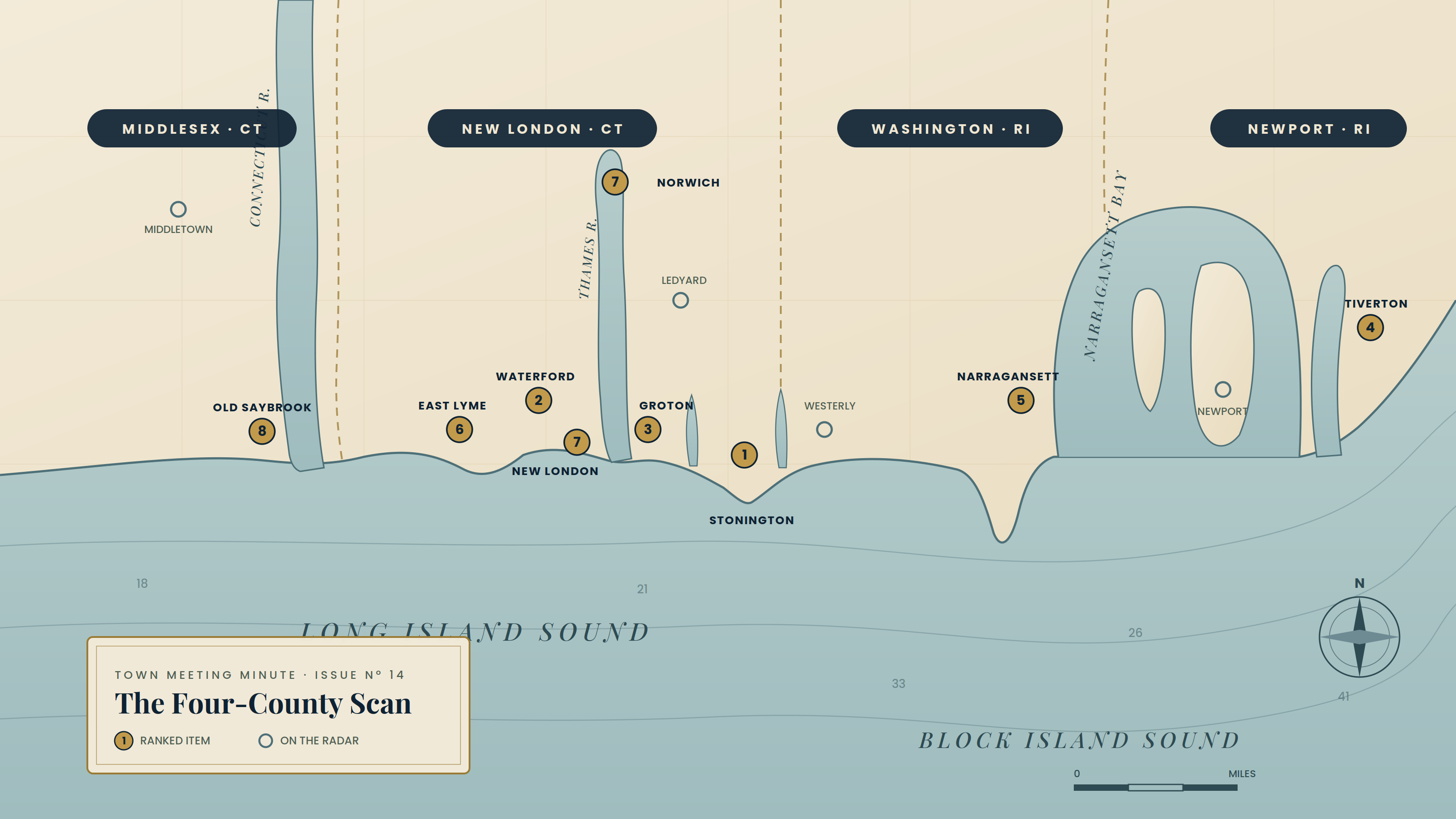
The rankings below are based on potential market impact, not political importance or likelihood of approval. A lower-ranked item may still be highly important to a specific neighborhood, property owner, applicant, or community group.
| Rank | County | Town | Item | Score | Why It Matters |
|---|---|---|---|---|---|
| 1 | New London CT | Stonington | 2026 POCD Continued Hearing & Adoption Vote | 9.5 | Public pressure is amending the plan before adoption, and the August 18 hearing may close the record on a decade of policy. |
| 2 | New London CT | Waterford | 140 Waterford Parkway South Decision Watch | 9.2 | The vote on the town-initiated rezoning will define the future of the region's largest housing-capable parcel. |
| 3 | New London CT | Groton | REGA26-0004 Denied; New Commercial Applications | 8.8 | The denial fixes the Open Space CIC rules as adopted, while Mystic and Long Hill Road show fresh commercial demand. |
| 4 | Newport RI | Tiverton | Seasons Corner Market — September 15 Special Meeting | 8.3 | A years-long, litigated commercial entitlement is finally approaching a preliminary-plan answer, with region-wide lessons on approval risk. |
| 5 | Washington RI | Narragansett | Comprehensive Plan Update — Housing Data | 7.9 | The town's own materials quantify a stark affordability gap that will shape the plan's housing strategies. |
| 6 | New London CT | East Lyme | Holmes Road Subdivision & Regulation Revisions | 7.6 | A live subdivision and a regulation rewrite in the same season will define delivery economics for future housing. |
| 7 | New London CT | New London & Norwich | MRDA Membership & Housing Growth Zones | 7.4 | State bonding funds for transit-oriented and downtown housing could redraw the redevelopment map in both cities. |
| 8 | Middlesex CT | Old Saybrook | Middle Housing & Housing Growth Plan Transition | 7.0 | Middle housing, mixed-use zoning, and parking rules could quietly reshape shoreline redevelopment options. |

The Big Picture
Issue #14 shows the other half of municipal control: accountability to the public and to the record. Towns that spent the spring writing frameworks are now defending them in crowded hearing rooms, amending them under pressure, and in some cases voting them down. Stonington is rewriting its ten-year plan in response to residents. Waterford is deciding whether its own rezoning survives its own process. Groton drew a line on how far a new tool can be stretched. Tiverton is being pushed toward a decision by procedure, litigation, and time.
The common thread is resolution. The frameworks phase is ending, and the outcomes phase is beginning — and outcomes, unlike frameworks, get recorded, take effect, and start moving value.
Seaport Takeaway: The next thirty days will produce more recorded land-use decisions in this region than the previous ninety. The owners who benefit will be the ones who read the decisions — not just the headlines — and reposition before the market prices them in.
Why We Track This
At Seaport Real Estate Services, we believe the best real estate advice starts before a property hits the market. Municipal agendas, zoning text amendments, map changes, public hearing notices, water and sewer studies, POCD updates, and subdivision regulations often reveal where value is being created, constrained, or redirected.
That is why we read the packets, track the meetings, and look for the connection between public policy and private real estate value.
Enjoy this blog post? Click here to subscribe for updates
Leave A Comment