
The Multifamily Brief: Submarines, Statutes & a Thousand New Doors
Everything moving the multifamily market in New London, Middlesex, Washington, and Newport Counties — the demand engine, the capital, the pipeline, and the two statehouses rewriting the rules.
There are markets where multifamily is a spreadsheet exercise. Southeastern Connecticut and southern Rhode Island are not one of them. Here, the story writes itself in steel: one employer planning 8,000 hires in a single year, a $76.6 billion Navy award, and a housing stock that was never built to absorb it. Layer on the most consequential rewrite of land-use law either state has seen in a generation, and you get the rare moment when demand, capital, and regulation are all pulling the same direction. This special edition maps all of it.
- Demand: Electric Boat plans roughly 8,000 hires in 2026 alone — about 3,500 at Quonset Point, 2,500 tradespeople in Groton — on the back of the largest contract award in its 127-year history.
- Capital: Institutional buyers have arrived inside our footprint: a $121M, 693-unit portfolio trade included 305 units in Groton and Norwich, and a 136-unit New London portfolio moved for $17.3M.
- Supply: More than 1,000 new units are delivered, approved, or pending in Groton and Stonington alone — and it still isn’t enough. Over 82% of Groton’s workforce commutes in.
- Rules: Connecticut’s HB 8002 and Rhode Island’s 2025 housing package both took effect January 1, 2026 — parking minimums slashed, conversions unlocked, and a June 2028 planning deadline with real teeth.
The Demand Engine: 8,000 Hires and a $76.6B Anchor
Every rent roll in this region ultimately traces back to the Thames River. General Dynamics Electric Boat — already employing more than 27,000 people — plans to hire roughly 8,000 workers in 2026, more than double its 2025 pace. The internal breakdown: about 3,500 at Quonset Point in North Kingstown, RI; roughly 2,500 tradespeople in Groton; about 1,000 in engineering and design; and another 1,000 across other functions. EB’s own talent leadership calls this the strongest hiring demand in more than two decades — and describes it as a peak that will continue for several years.
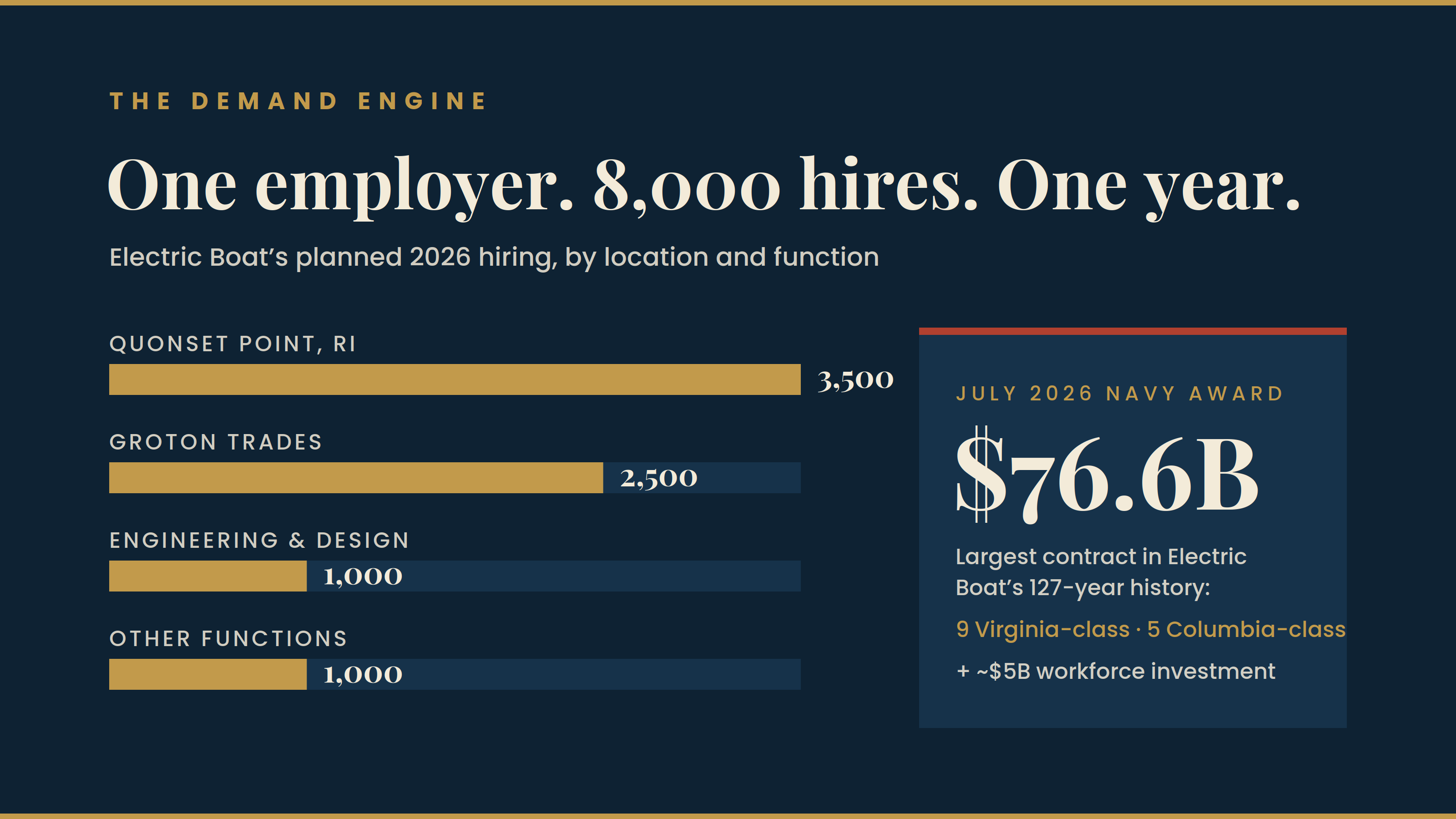
The fuel behind it: a $76.6 billion Navy award announced July 29, 2026 — $42.1B for nine Block VI Virginia-class attack submarines, $29.5B for five Build II Columbia-class boats, and roughly $5B earmarked for workforce and industrial-base investment. This is not a cyclical bump. It is a multi-decade production program with congressional backing.
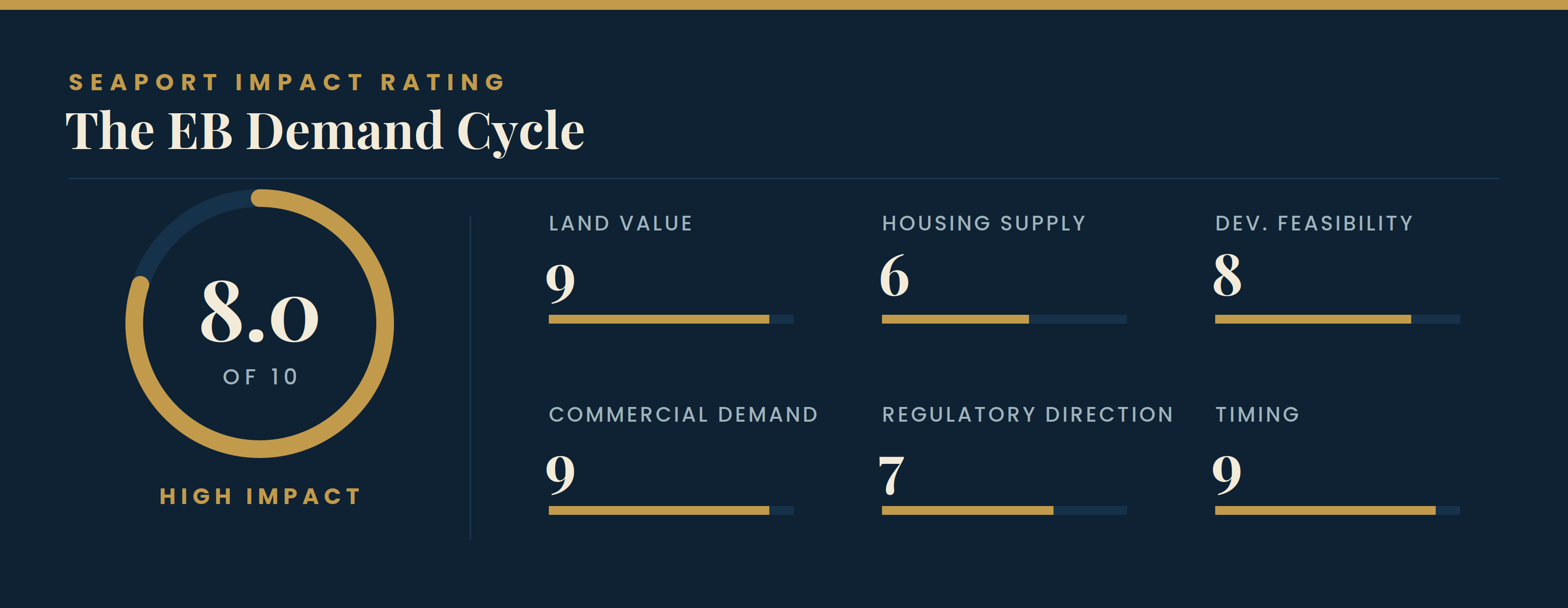
Now the friction: Groton hosts 27,000+ jobs, yet more than 82% of its workforce commutes in because there is nowhere to live. The town’s population has been essentially flat while household sizes shrink — meaning unit demand rises even without population growth. Meanwhile, New London’s average asking rent actually fell 2.28% year-over-year to $1,656 in early 2026 even as hiring accelerated — a dislocation between the demand story and current pricing that patient investors should be underwriting closely. New construction tells the other half of the story: Harbor Heights in Mystic asks $2,180–$4,375, Stonington Village in Pawcatuck $2,200–$4,100, and Triton Square in Groton from about $1,975.
Capital Watch: The Institutions Have Found the Chart
For years, southeastern Connecticut multifamily traded mostly among local and regional owners. That era is ending. The clearest signal came in June 2025, when a $121 million, four-property, 693-unit portfolio changed hands — and 305 of those units sit squarely in our footprint: Peppertree in Groton (205 units, built 1975) and Huntington Ridge in Norwich (100 units, built 2004). The buyer, a national workforce-housing operator with a track record of 165,000+ units, immediately folded Peppertree into its renovation platform. The thesis, in the buyer’s own framing: well-located Class B assets in Connecticut’s most resilient submarkets, bought for high occupancy and steady rent growth.
Per-unit figures are blended estimates; individual asset allocations and cap rates were not publicly disclosed.
The Pipeline: A Thousand Doors and Counting
Groton and Stonington are carrying the region’s supply response almost single-handedly — and even so, the math falls short of 8,000 hires a year. Here is the board as it stands:
Five 5-story buildings on 18 acres above Gold Star Highway. The largest single approval in the region’s modern pipeline.
Studio through 2BR on the former Seely School site; first occupancy spring 2025, rents from ~$1,975.
Beacon and Enclave phases nearly full; a 44-unit luxury townhome final phase cleared wetlands with completion targeted fall 2027. Marketed openly toward senior EB engineers and downsizers.
Mixed-use with ~10,000 SF of retail near the Westerly Amtrak station; ~25 middle-income units count toward the town’s 10% affordability goal.
375 Drozdyk Drive. On the town’s development ledger but no building permits yet — a name to watch, not to count.
Lofts on Fairgrounds (275 units, South Kingstown, conceptual master plan); Southpoint Commons (72 units, Westerly, under construction, 57 affordable); Rosebrook Commons (144 units, Middletown); Polo Center (60 units, Middletown). Narragansett, meanwhile, moved the other way — restricting multifamily in its high-density zones.
The counterpoint deserves its own line: roughly 600+ new units will land between 2026 and 2028 in the Groton–Stonington corridor alone. Lease-up assumptions on new product should be staggered accordingly — the demand story is real, but so is the delivery calendar.
Policy Watch: Two Statehouses, One Direction
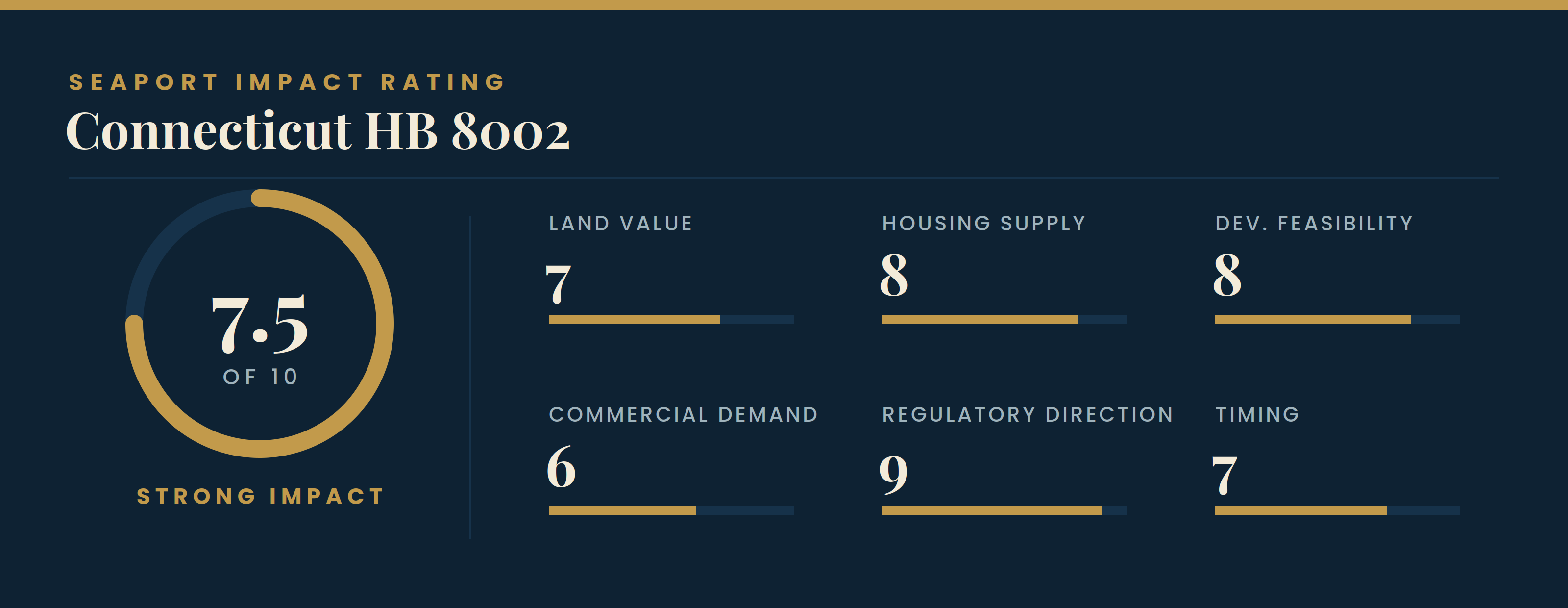
Connecticut: HB 8002 has teeth
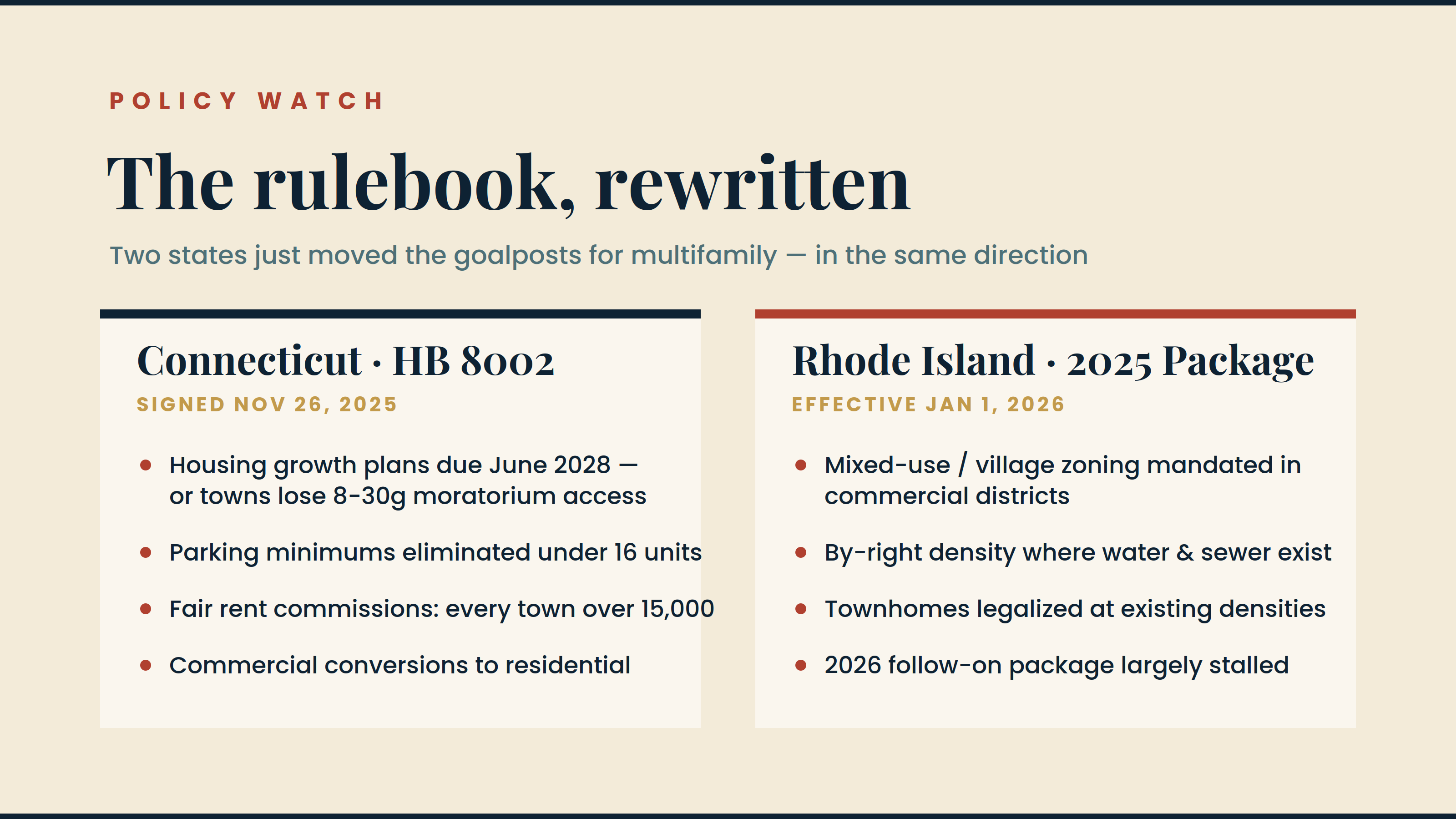
Signed November 26, 2025 after the veto-and-special-session saga, “An Act Concerning Housing Growth” is the most consequential CT land-use law in decades. The mechanics that matter for multifamily: every town must adopt a housing growth plan — its own, or a regional plan through its Council of Governments — and both SCCOG and RiverCOG towns face a June 2028 submission deadline. Miss it, and a town loses eligibility for the 8-30g affordable-housing appeals moratorium. That is real leverage: the moratorium threshold also drops from 2% to 1.75% of housing stock, and new “priority housing development zones” offer as-of-right construction paths.
Beyond planning: parking minimums are eliminated for developments under 16 units statewide (the old local opt-out is gone), middle housing of 2–9 units gets a summary process in commercial and mixed-use zones, commercial-to-residential conversions are expressly enabled, and fair rent commissions now reach every town over 15,000 residents — which in our footprint pulls in Groton, New London, Norwich, Stonington, East Lyme, Waterford, and Middletown. Algorithmic rent-setting software is banned outright. Infrastructure grant money through OPM is tied to plan compliance — carrot and stick in the same statute.
Rhode Island: the 2025 package landed, the 2026 sequel stalled
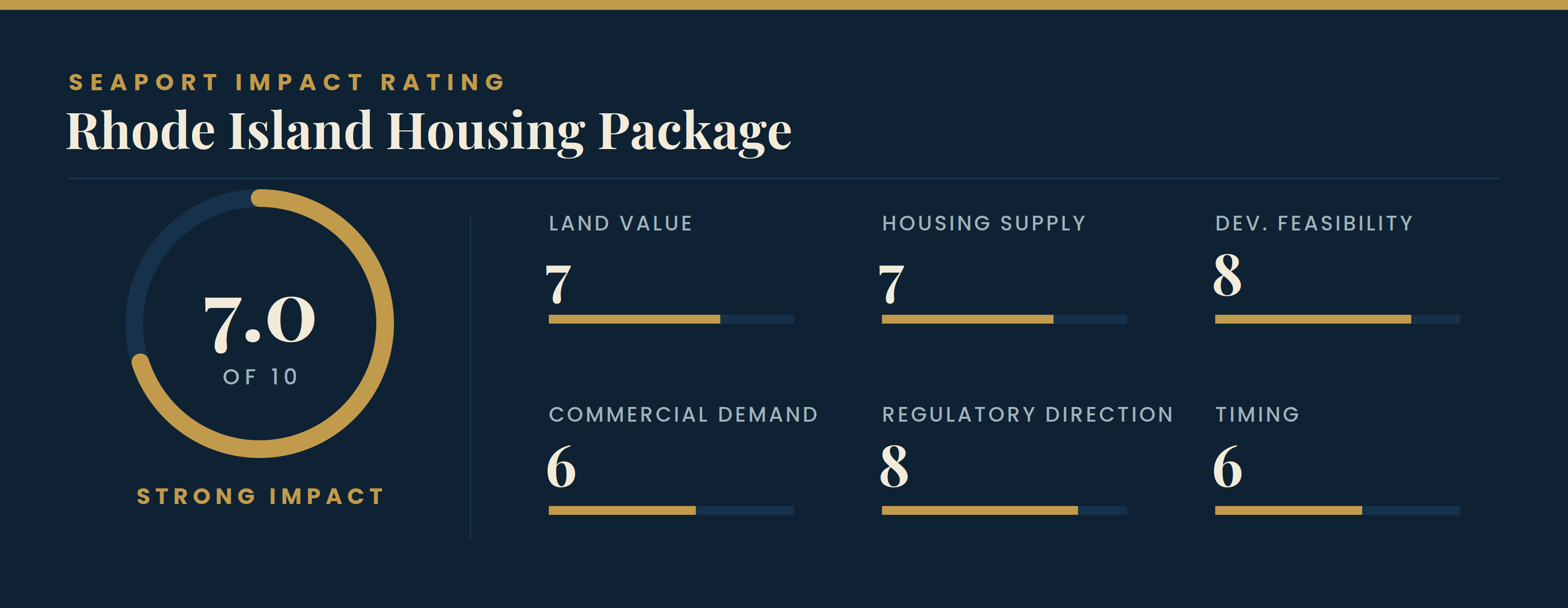
Rhode Island’s 2025 six-bill package took effect January 1, 2026, and it changes the map in Washington and Newport Counties: municipalities must provide village or mixed-use zoning allowing residential use in commercial districts; where public water and sewer exist inside the urban-services boundary, zoning must allow density beyond single-family by right; townhomes are legalized wherever equivalent density is already permitted; and e-permitting expands to DEM, CRMC, and DOT by October 2026.
The 2026 follow-on was a different story. With Speaker Shekarchi’s departure, most of the nine-bill package stalled — including the single-staircase reform (up to 4 floors / 16 units) that would have transformed small-lot infill math, and the tax cap on new affordable-inclusive rentals. Parking maximums near transit and Zoning Enabling Act cleanups did pass. Advocates plan a 2027 reintroduction; small-scale developers should treat single-stair as a live watch item, not a dead letter.
The Opportunity Radar
Where does all of this leave an investor or developer looking at the next 24 months? Five plays stand out:
One: Class B value-add in the commute shed — the $121M portfolio trade validated the thesis at institutional scale, and 1970s-era stock with loss-to-lease sits directly in the hiring path. Two: small stabilized portfolios in Norwich at double-digit in-place yields, still accessible to private capital. Three: commercial-to-residential conversion, now expressly enabled in both states — Groton’s hotel conversions already prove the model locally. Four: sub-16-unit infill, where the parking-minimum repeal materially changes per-unit land efficiency in downtown New London and Norwich. Five: the entitlement window — filing before towns adopt their (potentially restrictive) housing growth plans ahead of June 2028, and using 8-30g and RI comprehensive permits in low-affordability suburbs where the leverage is strongest.
Two Ways Into This Market, Right Now
Crystal Lake Apartments — a fully approved 92-unit development, Groton
Everything this issue describes about approval scarcity is exactly why Crystal Lake matters. Located at 0 Crystal Lake Road in Groton, the project received Special Permit and Site Plan approval from the Groton Planning & Zoning Commission on August 12, 2025: 92 units (64 studios, 28 one-bedrooms) across two 3-story buildings on roughly 8.4 acres, with a clubhouse, 99 parking spaces, EV infrastructure, recreation areas, and a multi-use trail connection. In a market where entitlement is the scarcest input, this is a defined project — approvals, elevations, floor plans, and unit mix in hand — sized precisely for the workforce renter the region is short on.
The Tides — leasing now at 135 Gold Star Highway, Groton
The commercial-to-residential conversion play isn’t theoretical here — it’s leasing. The former Days Inn at 135 Gold Star Highway has been reborn as The Tides, a 60-unit apartment community placed squarely in the EB commute path. Andrew O’Reilly of Seaport Real Estate Services is handling leasing — reach out for availability, floor plans, and pricing.
The Last Word
Markets rarely hand you a demand driver this legible. A submarine program funded for decades, a workforce doubling its hiring pace, two legislatures dismantling the frictions that kept supply scarce — and a pricing environment where the existing stock hasn’t yet repriced to the story. The gap between what this region will need and what is currently approved is measured in thousands of doors. The investors who do the town-by-town homework now — before the housing growth plans are written and before the next delivery wave leases up — will be the ones the next issue of this newsletter writes about.
Enjoy this blog post? Click here to subscribe for updates
Leave A Comment