
The 50% Rule Isn’t One Rule. That’s Why So Many Renovations Go Sideways.
Three separate rules share the same number. Almost nobody separates them — and in Connecticut, the one that decides your project is written by your town, not the state.

A few days ago a group of us got into it over the 50% rule — the one that says you can only renovate a house in a flood zone so far before the whole building has to come up to current code. Everyone in the room knew the rule. Everyone in the room had a different version of it.
That’s not a knowledge problem. It’s that three separate rules share the same number, and almost nobody separates them.
What is the 50% rule?
In its most common form, it comes from the National Flood Insurance Program. Under 44 CFR 59.1, any reconstruction, rehabilitation, addition, or improvement costing 50% or more of the structure’s market value before you start is a “substantial improvement.” Cross that line and the entire building — not just the part you touched — has to meet current floodplain standards. Elevation above base flood elevation. Flood-resistant materials below that line. Flood vents. Utilities raised.
That’s the rule people mean. But there are two others wearing the same jersey.
|
Federal · 44 CFR 59.1
Substantial improvement. Flood zones only. Your town sets the lookback window.
|
|
Rhode Island · RIGL 23-27.3-106
State building code. Every building in the state, flood zone or not. Fixed twelve-month window.
|
|
Local · Town Zoning
Nonconformity threshold. Governs whether you keep the grandfathered setbacks that let your house sit where it does.
|
When four people argue about the 50% rule, they’re often each right about a different rule.
In Connecticut, your town writes it
Here’s what surprises people: Connecticut has no statewide 50% statute for private renovation. The federal definition sets the floor, but the operative language lives in each municipality’s flood hazard overlay. Which means the answer genuinely changes at the town line.
The variable that matters most isn’t the 50%. It’s the lookback window — the period over which your town adds up improvement costs.
Some towns count a single permit. Some count one year. Some count ten. Some count the life of the structure. A $90,000 renovation on a $250,000 house is comfortably under the line if only this permit counts, and well over it if the town adds in the kitchen you did four years ago and the roof from the year before that.
Same house. Same budget. Same 50%. Opposite answers.
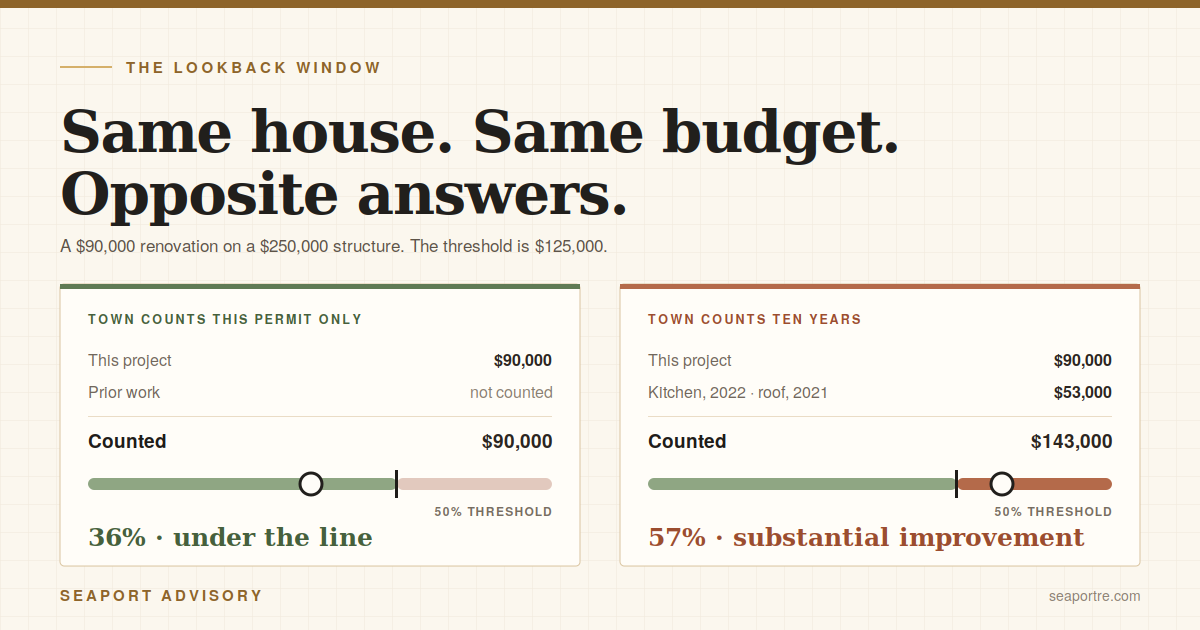
The threshold never moves. The window does.
Stonington currently runs a one-year window. During its recent zoning update the town floated extending that period — the proposal drew real public opposition and was tabled. So even where we know the answer today, it isn’t necessarily settled.
We built a Connecticut 50% Rule Calculator that makes the lookback window an input rather than an assumption, precisely because it varies. Where we’ve confirmed a town’s window from its adopted regulation, the tool fills it in. Where we haven’t, it says so — and tells you who to call.
The number most people get wrong
The 50% is measured against the value of the structure alone. Land is excluded.
On a waterfront parcel in Mystic or Stonington, that distinction is enormous. A $900,000 property might carry a $300,000 building — and the threshold is $150,000, not $450,000. People scope renovations against the purchase price and walk into a substantial improvement determination they never saw coming.
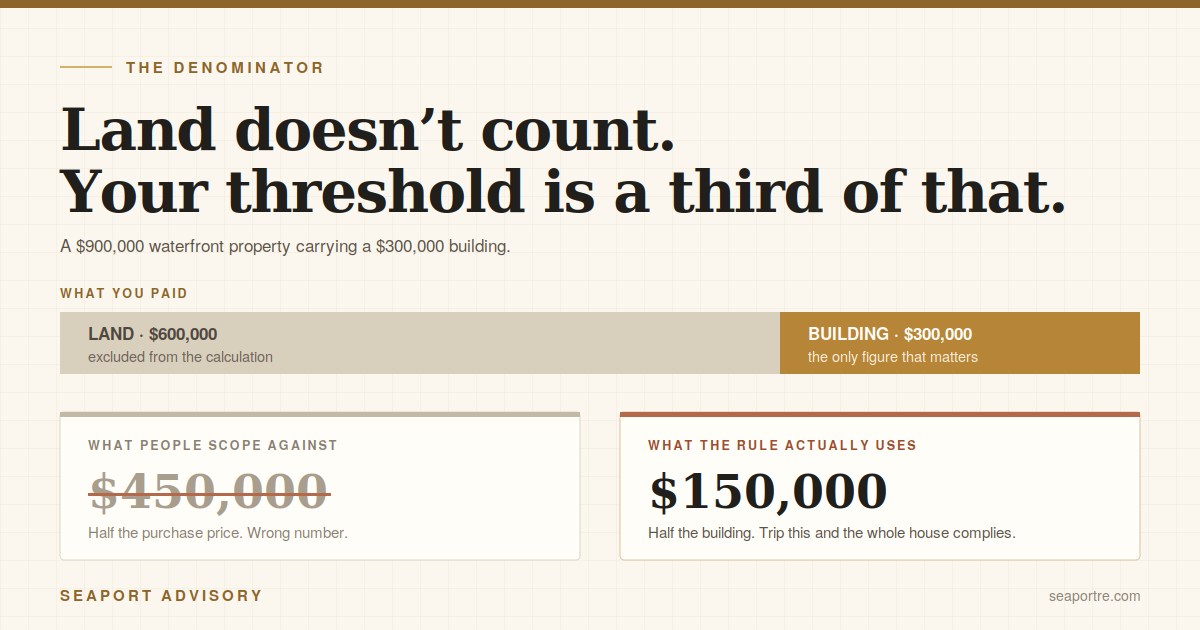
Half the purchase price is the wrong number. Half the building is the right one.
FEMA’s guidance accepts several ways to establish that value: an independent appraisal, an actual-cash-value estimate with depreciation, the local official’s qualified estimate, or the assessed value adjusted for the assessment ratio with land backed out. Those methods can produce meaningfully different numbers for the same house.
Most owners default to the assessor’s card because it’s free and sitting right there. When it understates the building, a defensible appraisal is the single most effective lever available — and it’s completely legitimate. You’re not gaming anything. You’re establishing the correct denominator.
Three traps worth knowing
Groton is two jurisdictions
The Town of Groton and the City of Groton have separate land use authority and separate regulations. Stonington and Stonington Borough likewise. Confirming which one governs your parcel is step one, not a footnote.
Elevating can cost you your height
Rhode Island solved this — state law lets you measure building height from base flood elevation and excludes up to five feet of freeboard from the calculation. Connecticut has no statewide equivalent. Here, raising a house often pushes it past the district height limit and into a zoning variance on top of everything else. Check the height math before you promise anyone that elevating is straightforward.
The historic exclusion is real, and underused
Alterations to a historic structure are excluded from the substantial improvement calculation, provided the work won’t preclude continued historic designation. In Mystic, Stonington Borough, and other listed districts, that’s a genuine tool — one that needs to be coordinated with the State Historic Preservation Office rather than assumed.
What changed in the last year
|
In effect
October 1
2025 |
Every new single-family home inside Connecticut’s coastal boundary requires local site plan approval — towns can no longer exempt them. Where the parcel also sits in a mapped flood zone, that coastal site plan must be referred to DEEP for comment. More process, longer timelines. |
|
In effect
July 1
2026 |
Connecticut’s residential property condition disclosure carries a new Flood Risk Awareness section: flood zone, prior disaster assistance, current flood insurance, whether an elevation certificate exists, past claims, and any history of water penetration. Lenders now have to notify mortgage applicants about flood coverage at least ten days before closing. |
If you’re selling a shoreline property that’s been renovated, those questions are on the form now.
The honest version of “phasing”
People ask whether you can split a renovation across permits to stay under the line.
Where a town counts a short window and the projects are genuinely separate — different scopes, years apart, independently conceived — spacing work out is ordinary and lawful. Where it’s one planned renovation chopped into sequential permits to dodge a threshold, that’s a different thing. Building officials recognize the pattern, and the consequence isn’t a warning. It’s a stop-work order halfway through the job, with an unfinished house and a compliance problem attached to the title.
We’ll help you understand the window. We won’t help you disguise a project inside it. Those aren’t the same service.
Where to start
Before scoping anything on or near the water, get three answers from the town’s floodplain administrator — a role that might sit with the zoning enforcement officer, the building official, or the town engineer depending on where you are:
|
1
|
Over what period do you add up improvement costs? |
|
2
|
What structure value will you accept, and will you take an independent appraisal? |
|
3
|
How much freeboard do you require above base flood elevation, and is this parcel inside the coastal boundary? |
The calculator looks up your flood zone from the FEMA National Flood Hazard Layer, shows how much room you have before the threshold, and gives you the phone number for your town where we’ve confirmed it.
Open the CT 50% Rule Calculator →Neither one replaces the determination your building official makes. Nothing does. But walking into that conversation knowing which questions matter is the difference between a renovation that goes to plan and one that stops in week six.
Seaport Real Estate Services advises buyers, sellers, and owners across southeastern Connecticut and southern Rhode Island. If you’re weighing a renovation on or near the water, reach out — we’d rather talk through it before the scope is set than after.
This article is general information, not legal or engineering advice. Substantial improvement determinations are made by local building officials and floodplain administrators. Confirm any town-specific figure with the municipality before relying on it.
Enjoy this blog post? Click here to subscribe for updates
Leave A Comment