

Housing Pressure Moves From Policy to Parcels
Across Southeastern Connecticut, local boards are moving from discussion to action — studying rezoning requests, updating subdivision rules, reviewing utility costs, and implementing state housing mandates that could reshape land values and development feasibility.
Real estate value does not usually change all at once. It changes first in meeting packets, public hearing notices, water-rate studies, subdivision regulations, zoning referrals, and long-range planning documents. By the time a shovel hits the ground, the value shift may have already started.
Top Story
Waterford’s 140 Waterford Parkway South rezoning request places a large industrial parcel directly into the housing and mixed-use conversation.
Key Dates
June 15–23, 2026 — housing-growth seminars, planning hearings, utility studies, and subdivision regulation work are all in motion.
Big Theme
The next real estate story is being shaped by zoning, infrastructure, utility costs, and parcel-level implementation.
What We’re Watching Over the Next Two Weeks
This issue is less about one headline-grabbing approval and more about the machinery behind future growth. Groton is continuing work around its long-range plan. East Lyme is processing state housing growth requirements and subdivision regulations. Waterford is reviewing both a major rezoning request and utility-rate issues. Norwich is advancing smaller but meaningful infill and reuse items.
These are the kinds of municipal signals that matter before the broader market notices. They do not always look dramatic on an agenda, but they often help determine where future housing supply can go, what land may be worth, and whether a development can actually pencil.
Want to Follow the Public Meetings Yourself?
Below are the highest-impact meetings and source pages we are tracking for this issue. Meeting formats, agenda links, public comment rules, and packet materials can change, so always confirm directly with the town before attending, watching, or submitting public comment.
Waterford Planning & Zoning Commission
Date: June 23, 2026
Time: 6:30 PM
Why it matters: 140 Waterford Parkway South rezoning request.
View Waterford AgendaEast Lyme Planning Commission
Date: June 15, 2026
Item: Housing Growth Seminar / SSPA 25-1
Why it matters: State housing policy is moving into local zoning implementation.
View East Lyme AgendasGroton Planning & Zoning Commission
Date: June 23, 2026
Time: 7:00 PM
Why it matters: Groton 2035 and long-range land-use direction.
View Groton Agenda PortalNorwich Commission on the City Plan
Date: June 16, 2026
Item: Mixed-use renovation, accessory housing, shelter use, and commercial reuse.
Why it matters: Infill and adaptive reuse continue to shape small-city growth.
View Norwich Agenda CenterHow We Think About Impact
Each item in Town Meeting Minute is assigned a Seaport Impact Score from 1 to 10. This is not an official municipal score, and it is not a prediction that an application will be approved or denied. It is our internal editorial framework for evaluating how much a meeting item could matter to property owners, investors, developers, tenants, and the broader real estate market.
A higher score means the item has a greater potential to influence land value, housing supply, development feasibility, commercial demand, infrastructure planning, or the long-term direction of a town. A lower score does not mean the item is unimportant; it simply means the likely market impact is more limited, more localized, or less immediate.
Land Value
Could this change what a site is worth, how it is positioned, or what a buyer may be willing to pay?
Housing Supply
Could this create, limit, redirect, or influence future housing units?
Development Feasibility
Could this affect whether a project can realistically be built based on zoning, infrastructure, cost, or approvals?
Commercial Demand
Could this affect tenant demand, corridor viability, business expansion, or adaptive reuse?
Regulatory Direction
Does this show where the town may be heading on density, conservation, infrastructure, or economic development?
Timing
Is there a hearing, vote, policy change, funding decision, or application milestone coming soon?
How to read the score: Items scoring above 8 are high-impact signals that could influence broader market direction or future land-use strategy. Items between 6 and 8 are meaningful watch-list items. Items below 6 may still matter locally, but the likely market impact is narrower or more property-specific.
Highest Impact Item
1. Waterford: 140 Waterford Parkway South Rezoning Request
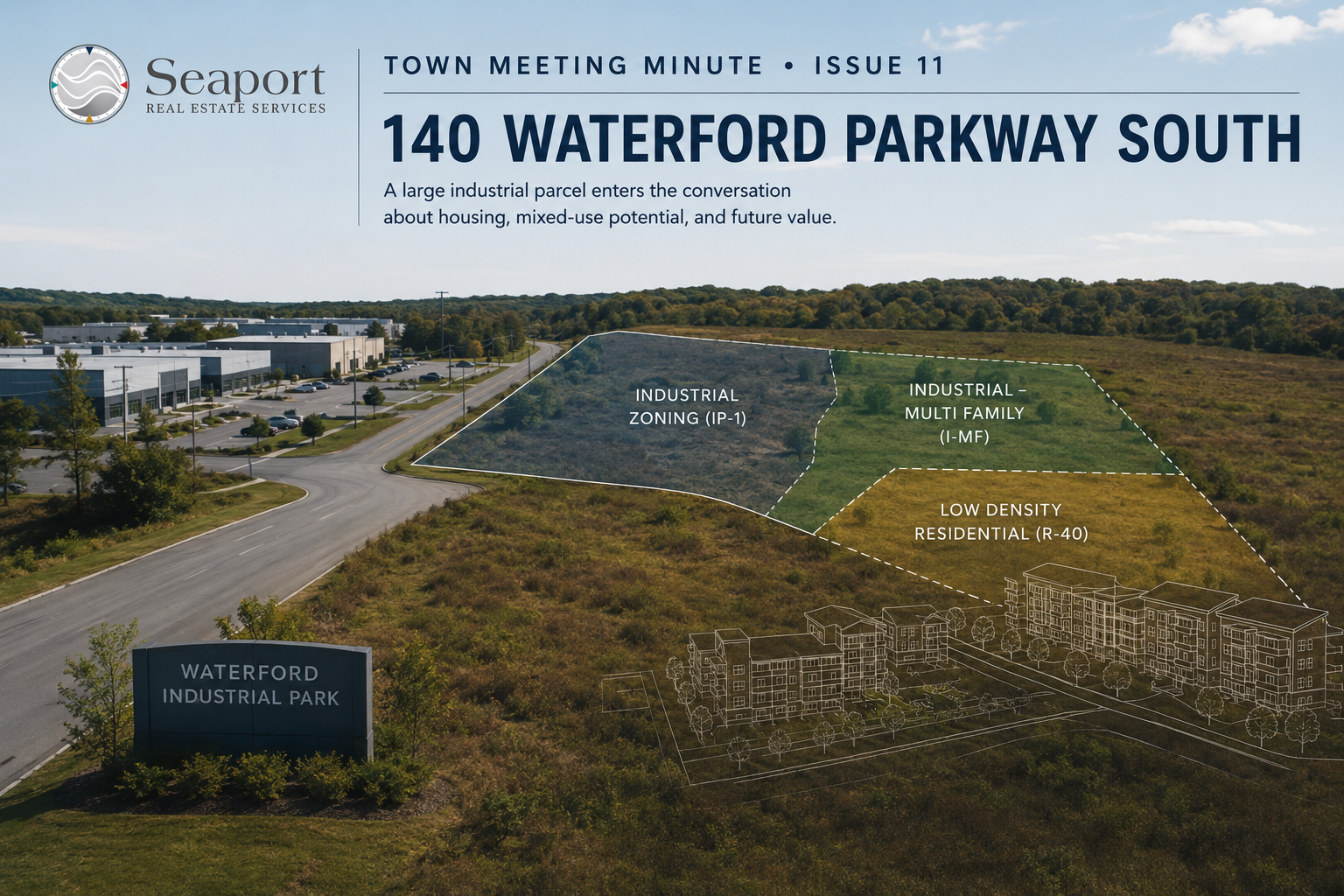
This is the cleanest market-facing item in Issue #11. A large industrial parcel entering a rezoning conversation is not just a technical land-use matter. It raises a much bigger question: how much of the region’s future housing supply may come from land that was previously viewed through an industrial or business-park lens?
Why This Could Change the Game
Large parcels are rare. Large parcels with infrastructure, road access, and the possibility of a revised land-use framework are even rarer. If a site like this begins to shift from a traditional industrial-only profile toward a mixed industrial, multifamily, or residential conversation, the implications extend beyond one property.
It affects nearby landowners, future housing supply, municipal tax-base planning, infrastructure demand, and the way investors evaluate underutilized business-park land throughout the region.
Seaport Read
This is not simply about whether one rezoning request moves forward. The bigger signal is that land-use flexibility is becoming part of the housing response. In markets where developable residential land is constrained, the next wave of value may come from parcels that can be repositioned through zoning, infrastructure, and long-range planning.
2. Groton: Groton 2035 and the Long-Range Planning Playbook
Groton continues to be one of the most important land-use towns in Southeastern Connecticut. Between Electric Boat, Pfizer, the submarine base, Mystic, shoreline constraints, infrastructure limitations, and housing demand, Groton’s long-range planning work deserves close attention.
Groton 2035 is not just a planning document. It is a policy framework that can influence how town officials evaluate future housing, open space, commercial corridors, conservation priorities, infrastructure investment, and neighborhood character.
Why This Could Change the Game
A Plan of Conservation and Development does not approve a project on its own. But it can shape the language and logic that future applications must respond to. When a town’s long-range plan identifies where growth should go, where it should not go, and what infrastructure or neighborhood principles matter most, it becomes part of the regulatory environment.
Seaport Read
In Groton, the market pressure is already here. The question is whether the regulatory structure can absorb that pressure in a way that creates housing, preserves important resources, and maintains the character that gives the town its value in the first place.
3. East Lyme: Housing Growth Policy Reaches the Local Desk
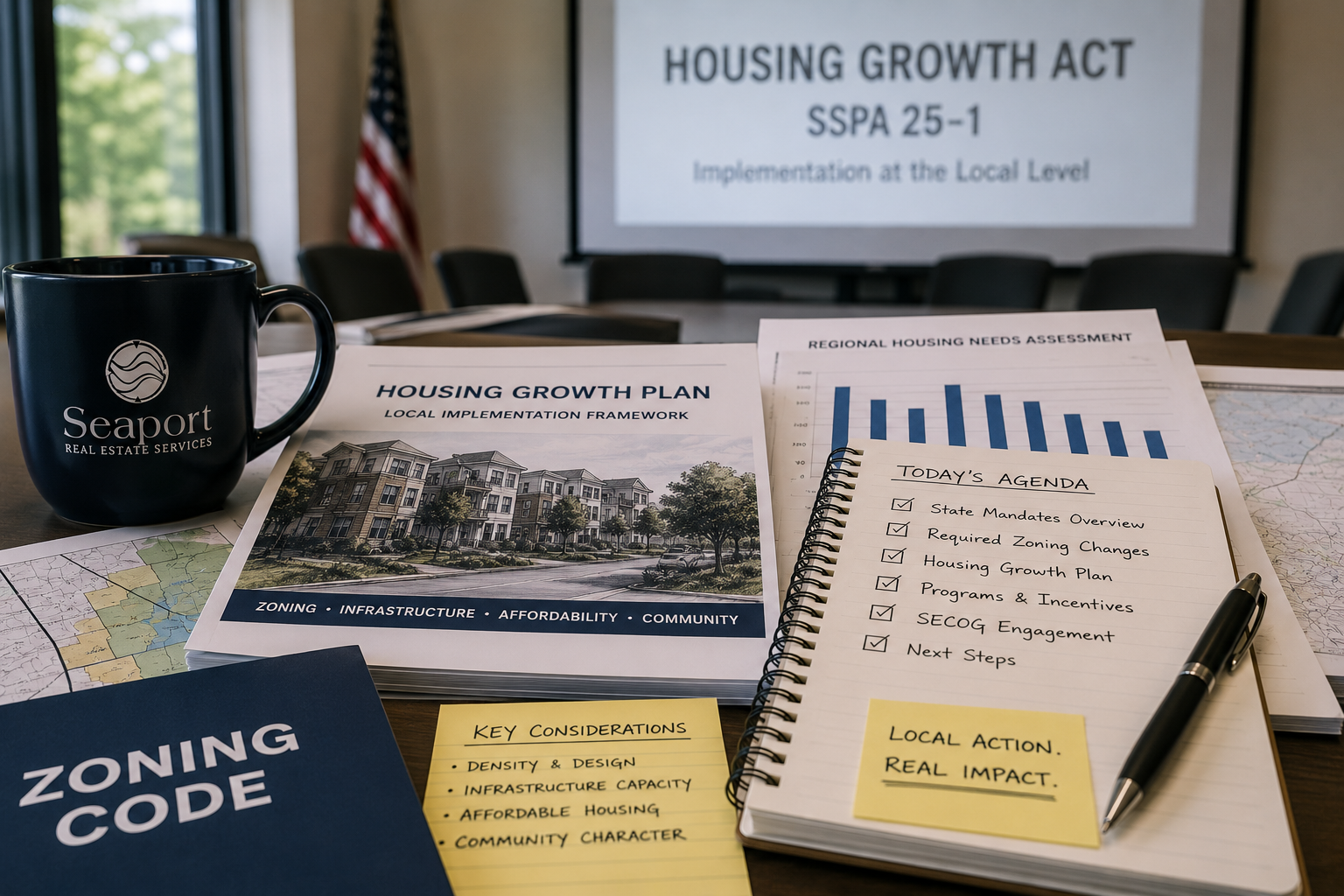
East Lyme’s housing-growth seminar is one of the clearest examples of state housing policy moving from theory into local implementation. The topics being discussed — required zoning changes, housing growth plans, regional housing needs, incentives, and municipal engagement — are exactly where broad housing policy becomes town-by-town zoning work.
Why This Could Change the Game
Housing policy does not become real estate supply until local commissions, boards, and staff translate it into zoning language, review procedures, infrastructure planning, and parcel-level feasibility. East Lyme is now working through that translation.
Seaport Read
For landowners and developers, the important question is not only whether the state wants more housing. The question is how each town will implement those requirements. East Lyme’s process will be worth watching because implementation details could influence where new units are feasible, what densities are allowed, and how community character is protected.
4. East Lyme: Subdivision Rules and the Mechanics of Growth
While the housing-growth seminar is the policy story, East Lyme’s subdivision work is the practical story. Subdivision rules determine how land can be divided, what infrastructure is required, how open space is handled, what waivers may apply, and whether a residential project can actually move from concept to approval.
These details matter. Test pits, potable water, sewerage systems, underground utilities, open space, easements, and waiver language can all affect project cost, lot yield, timing, and ultimate feasibility.
Seaport Read
If the housing-growth conversation is about goals, subdivision regulations are about execution. This is where future supply is either enabled or constrained.
5. The Infrastructure Squeeze: Water, Sewer, PFAS, and Utility Rates
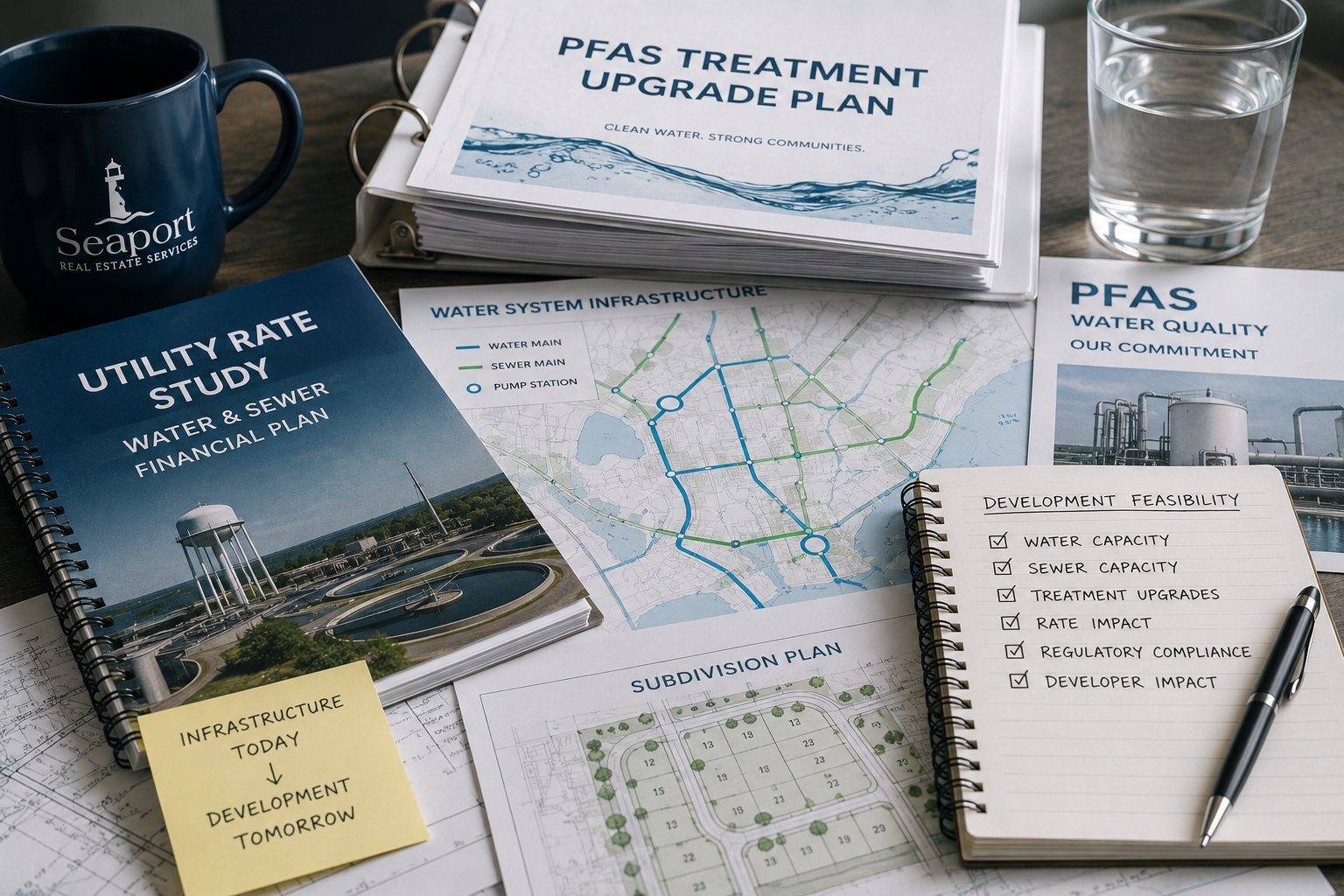
Zoning gets most of the attention, but infrastructure may be the real limiting factor. Water capacity, sewer capacity, PFAS treatment, rate structures, and interlocal agreements all affect whether housing and commercial projects can be supported.
When utility costs rise, the impact does not stay inside the water department. It can flow into development fees, operating costs, rents, tax policy, construction feasibility, and long-term municipal growth strategy.
Why This Could Change the Game
A parcel can have favorable zoning and still be difficult to develop if utility infrastructure is expensive, limited, or uncertain. In the next phase of the market, the towns that can align zoning capacity with utility capacity may be better positioned to absorb housing demand.
Seaport Read
Infrastructure is becoming a real estate issue. Water and sewer planning are no longer background municipal functions. They are part of the value equation.
6. Norwich: Infill, Accessory Housing, and Commercial Reuse
Norwich continues to show how redevelopment often happens through smaller, incremental moves rather than one giant project. The June 16 Commission on the City Plan agenda includes several items that fit this pattern: downtown mixed-use renovation, additional one-bedroom units, accessory housing, a seasonal shelter use, and commercial pad reuse.
Why This Matters
Small-city revitalization is often cumulative. One upper-floor renovation, one accessory apartment, one commercial reuse, and one improved site plan may not transform a city by themselves. Together, they can change how a downtown functions and how existing buildings are valued.
Seaport Read
Norwich remains a market where investors should pay close attention to adaptive reuse, mixed-use buildings, upper-floor residential potential, and service-oriented commercial demand.
Other Items on Our Radar
Waterford: Village Residential Height Flexibility
Waterford’s earlier discussion around increasing maximum building height in certain Village Residential zones from 20 feet to 25 feet is a subtle but meaningful infill signal.
Impact Score: 6.5 / 10 — Watch List
Waterford: Small Commercial Reuse
The reuse of existing plaza space for service, wellness, educational, or fitness tenants remains an important indicator for older retail centers.
Impact Score: 5.8 / 10 — Moderate
Ledyard: Water and Sewer Review
WPCA discussions involving water, sewer rates, compliance costs, and development-related review remain worth tracking because infrastructure planning can affect future housing feasibility.
Impact Score: 6.8 / 10 — Watch List
Municipal Land and Open Space
Town-owned land, open-space funding, wetlands constraints, and long-range conservation planning continue to influence what can be developed and what should be preserved.
Impact Score: 6.1 / 10 — Watch List
Issue #11 Impact Rankings
| Rank | Town | Item | Score | Why It Matters |
|---|---|---|---|---|
| 1 | Waterford | 140 Waterford Parkway South Rezoning | 9.2 | Could reposition a large industrial parcel toward broader mixed-use or residential value. |
| 2 | Groton | Groton 2035 / POCD | 8.8 | Could shape future housing, conservation, infrastructure, and land-use policy. |
| 3 | East Lyme | Housing Growth Act Implementation | 8.4 | State housing policy is moving into local zoning and planning work. |
| 4 | East Lyme | Subdivision Regulation Revisions | 7.9 | Could affect feasibility, yield, infrastructure requirements, and future residential supply. |
| 5 | Waterford / East Lyme | Utility Rates, PFAS, Water and Sewer Planning | 7.7 | Infrastructure costs are becoming central to development economics. |
| 6 | Norwich | Downtown Infill and Commercial Reuse | 7.1 | Shows practical small-city redevelopment through adaptive reuse and additional housing units. |
| 7 | Ledyard | Water / Sewer Review and Development Feasibility | 6.8 | Utility capacity and rate structure may influence future residential development feasibility. |
The Big Picture
The next phase of growth in Southeastern Connecticut is being shaped by a combination of housing mandates, infrastructure costs, subdivision standards, and large-parcel zoning decisions. The market will eventually see the results in listings, rents, absorption, land values, and development proposals.
But the first signals are showing up now in town meeting packets.
Seaport Takeaway: The towns that can align land-use flexibility, infrastructure capacity, and community planning will be better positioned to absorb housing demand without losing the character that makes the region valuable.
Why We Track This
At Seaport Real Estate Services, we believe the best real estate advice starts before a property hits the market. Municipal agendas, zoning text amendments, water and sewer studies, economic-development plans, and public hearing notices often reveal where value is being created, constrained, or redirected.
That is why we read the packets, track the meetings, and look for the connection between public policy and private real estate value.
Enjoy this blog post? Click here to subscribe for updates
Leave A Comment